Friday, June 28, 2013

Waxabajjii 28-29, 2013: Waamicha Kora Gamtaa Kutaalee Awurooppaa Magaalaa Oslootti

Gadaa.com
Gadaa.com
Bakka: Galma Chilii eit Vet Veien 8 Veit Vet Senter Oslo T-bana. Lak. 5
(Metro lak.5) Giddugaleessa magaalaa Oslo irraa gara bahaa
(From Oslo Center East Bound – Vestli) Baasii lakk. 31 Giddugaleessa magaalaa Oslo irraa gara “Grorud jedhu yaabbattanii Veit vet irraa buutu”
KQ

Two Minnesota Mayors officially proclaim Oromo Week

b_400_300_16777215_00_images_minneapolisimages_saintpaulmayor(OPride) – In recognition of Oromos growing importance to their community, mayors of Minnesota’s Twin Cities on Thursday proclaimed the week of June 29 to July 6, 2013 as “Oromo Week” in Minneapolis and Saint Paul.
“An estimated 35,000 Oromo, most of whom refugee and asylees, have made Minneapolis and the Minneapolis/Saint Paul region their home, after fleeing persecution in their homeland,” Minneapolis Mayor R.T. Rybak wrote in a proclamation document given to leaders of the Oromo Community of Minnesota (OCM).
Rybak urged his residents to accord a warm welcome to guests coming from around the world to participate in the Annual Oromo Festival in North America during the week.
“Visitors from around the world will be participating in festival events including the Oromo Soccer Tournament, the International Oromia Youth conference, shows of worldwide artists, political and human rights conferences, and a host of cultural, religious and social gatherings,’” wrote Mayor Chris Coleman of Saint Paul  in a similarly worded proclamation.
Both Mayors underscored the contribution of Oromo expats to the vitality of their respective cities and the state of Minnesota as a whole.
Unofficially known as Little Oromia, Minnesota is home to the largest number of Oromo immigrants outside of the Horn of Africa. The Oromo are Ethiopia’s single largest ethno-national group, estimated at 40 million. According to estimates by Oromo Studies Association, there are currently over 150, 000 Oromos living in the United States.
“The recognition speaks to the vitality of the Oromo presence in the Twin Cities,” said Hassan Hussein, OCM’s Executive Director, in an email response to OPride.  “And more importantly to its universal message of community, beauty, unity in diversity, tolerance, and humanity’s most cherished and eternal ideal, liberty.”
–Full Report Opride

Monday, June 24, 2013

posted by Mesfin Tadese

Oromos seek justice in Ethiopia

Why is the largest ethnic group in Ethiopia also one of the most persecuted?
On Tuesday, June 25 at 19:30 GMT on The Stream, Aljazeera TV 
In USA, Eastern time:   3:30 PM 
oromoseekjustice
Ethiopians belonging to the Oromia ethnic pray for the souls of 63 young Oromo men who died at sea while trying to cross illegally from Libya to Italian Lampedusa island the week before, at the UAE (United Arab Emirates) Red Crescent refugee camp near the border crossing with Libya at Ras Jdir, Tunisia, 15 April 2011. EPA/AMEL PAIN
The Oromo people make up about 40 per cent of Ethiopia’s population, yet face widespread discrimination and have long been targeted by the government. So what should be done to stop the marginalization of the Oromos and end Ethiopia’s internal ethnic divide?
source: http://ayyaantuu.com/horn-of-africa-news/oromia/oromos-seek-justice-in-ethiopia/

World Refugee Day 2013 – How Oromo Refugees Marked the Day Across the Globe

The Oromo people make up the largest nation in the Horn of Africa and the Ethiopian empire, but it is a nation politically and economically marginalized and repressed for the last 120 years in its own homeland, Oromia. Due to the several decades-long conflict between Oromia and the Ethiopian government, thousands of civilian Oromos have fled their homes and sought shelters in neighboring countries, and some of them have then relocated to distant lands to call Europe, Australia, Asia and North America their new homes. On June 20, 2013, many of the Oromo refugee communities across the globe marked UNHCR’s World Refugee Day. Here is the roundup of the Oromo refugees marking this year’s World Refugee Day.
————————-
Egypt
As of the result of the Nile crises, the Oromo refugees in Cairo observed the World Refugee Day while camping outside the local UNHCR office in protest of the dam backlash endangering their lives once again. Since June 20, 2013, it’s been learnt that the Oromo refugees in Cairo are to be moved by UNHCR to a safer neighborhood in Cairo.

Kenya:
Videos: Oromo refugees performing Oromo cultural dances at the World Refugee Day ceremony in Nairobi, Kenya.
New York (USA):
Oromo nationals took center stage at the World Refugee Day parade in Syracuse, New York.
Gadaa.com
(Photo: Syracuse.com)

Sunday, June 16, 2013

Civil Servants in Oromia Forced to Become Members of the OPDO

Firehiwot Guluma Tezera | June 15, 2013
Firehiwot Guluma Tezera
TPLF is forcing Oromo civil servants to become member of the Oromo Peoples’ Democratic Organization (OPDO). The Oromo civil servants are now facing a choice between becoming member of the organization they hate to be associated with, and immerse their hands into the dirty work of OPDO, which is arresting, torturing, and killing innocent Oromo’s, or lose their jobs. Living under difficult economic situation, job loss is a very serious matter which is considered a suicide in the Empire, and, therefore, the Oromo civil servants will have to think twice before saying “no” to the warning of the Wayyaanee authorities and endangering their life and their families.
Contrary to its “democratic” naming, the so called OPDO is an undemocratic “organization” created by the Tigrai Peoples’ Liberation Front (TPLF), from the war prisoners of the former military junta, Mengistu Haile Mariam in the jungles of Tigrai. It is a pseudo organization completely controlled by ruling party, the TPLF. The TPLF regime uses this organization to arrest, harass, torture, and kill innocent Oromo’s who do not support their tyrannical rule. Moreover, the OPDO is used by the TPLF leaders as a tool to abuse their political power and exploit the entire economy of Oromia for their personal account and build their home base of Tigrai regional state.
Over the years the TPLF regime has been abusing its political power to put every sector of the Oromo society under its control by denying them their natural right. For instance the TPLF regime is notoriously known for:
  • using food aid for its political purpose by denying the donated food to those farmers who do not support and/or who are not members of OPDO,
  • using the distribution of fertilizer for its political purpose by denying fertilizer to those farmers who do not support their political agenda,
  • using job entrance criteria for its political purpose those who graduated from universities, colleges, and other educational and training institutions, to show their OPDO membership before they are employed.
  • using business license for political purpose by denying the businessmen the right to renew their business license and by over taxing them, and above all,
  • using its state apparatus such as police, judiciary, prosecutors, security personnel with plain clothes, and even the army, to unlawfully arrest, torture, convict, intimidate, and harass innocent Oromo’s who are not willing to support their anti-Oromo agenda.
Those Oromo’s who fill out the OPDO membership form are not only obliged to do their dirty work, but also forced to study the book prepared by the Wayyaanees, named “Addis Ra’iyi” meaning “New Vision” apparently explaining the “vision” of Wayyaanes, which is erasing Oromoness and the Oromo identity and replacing it by the newly invented “TPLF-Ethiopian” identity, by coming to a meeting every two weeks. Oromo civil servants are now forced to become OPDO member and study the material, which amounts to a trash, or lose their job.
It is a well-established fact that the Wayyaanee regime, since it assumed power in 1991, have been attempting to indoctrinate the Oromo civil servants non-stop but their dirty politics has been rejected not only by the Oromo’s but also by the entire population in the empire including the Amharas.

Wednesday, June 12, 2013

UN Human Rights Council – HRLHA | June 12, 2013

HRLHA-FineHRLHA | June 12, 2013
The Human Rights League of the Horn of Africa (HRLHA) has participated in the 23rd regular session of the UN Human Rights Council held at the UN Geneva Headquarters in Switzerland from May 27 to June 14, 2013. The event particularly hosted by the HRLHA on the past and present human rights situations in Ethiopia took place on the 6th of June, 2013.
HRLHA was represented, at the 23rd regular session, by Mr. Garoma B. Wakessa, the Executive Director of HRLHA and Mr. Tesfaye Deressa, Chief Investigator; and the representatives of HRLHA did presentations on the Adverse Roll of land grab and the encroachments of fundamental rights in Ethiopia respectively. In his presentation under the title “The Consequences of Land Grab in Ethiopia”, Mr. Garoma elaborated on how local farmers in various parts of the country, in Oromia, Gambella and Benshangul regional states in particular, were evicted from their lands and livelihoods without consent and compensations, and ended up in joblessness and poverty. He has also pointed at how the Ethiopian Government has violated the international laws and instruments that relate to investments and/or developments through partnerships of Transnational Corporations and local governments.
Mr. Tesfaye Deresaa on his part in his presentations under the title “The Encroachments of Fundamental Rights” discussed the direct and systematic denials of freedoms of expression, assembly and organization, religion, as well as the overall democracy and rule of law. Mr. Tesfaye underlined that, instead of the promised democracy, the exact replica of absolute authoritarianism of one party rule of the Dergue time has reigned in the country in the past twenty years, and that the democratization process has failed as a result of the denial of the fundamental freedoms.
The two presenters, among other things, reiterated that everything about democracy and fundamental rights was well-written in the Constitution and other relevant documents only to win acceptance by Western donors, and then to remain on paper. Representatives of the Ethiopian Government who attended the event had nothing to say in defending the ruling party, but admit failures and repeat the never unfulfilled promises to fix the problems.
Most of the Horn of African countries were represented by more than one human right organizations, whereas the Human Rights League of the Horn of Africa was the only agency to host an event on the current situations in Ethiopia as part of this 23rd regular session of the Human Rights Council.

Posted by Mesfin Tadese

The anguish of higher education students in Ethiopia


Academic activities such as studying, teaching, inventing, leading, administrating and other responsibilities in a university or college require at a minimum academic freedom. Unfortunately, however, academic freedom in higher education institutions of Ethiopia is drier than the Sahara desert.
        Ethiopians who have been part of these institutions as a student, teacher, or any other workers have been grilled by this desert. Although, no one can tell better than we, the victims of this inferno; national and international human rights organizations have documented the absence of freedom of expression, association, and assembly in the colleges and Universities of Ethiopia(1).
Higher-education students’ activities are monitored routinely by government agents who are registered as students while, in fact, their primary mission is spying for the minority government. These spy-government agents have total authority to report to the unprofessional and notorious police not only students who criticize the way the country or the government is run but also any students whom they suspect have such idea. Furthermore, the spy agents play the governments divide and rule game by promoting fight among students on ethnic line (2). As a result students live in fear of the government and each other. Only students loyal to the Ethiopian Peoples Democracy Front (EPRDF) in general and the Tigrai Libration Front (TPLF), in particular, could escape this harassment although they themselves could spy each other as well.
The TPLF Spy agents create a climate of fear in colleges and universities and exert strong pressure on every student to enroll as a party member as soon as the student joins the institution. Each student is supposed to be member of one of the four political parties which include the TPLF (the mastermind of ethnic division), Oromo People Democracy Organization (OPDO), Amhara National Democratic Movement (ANDM) and Southern Peoples Democratic Front (SEPDF) (3). Whether they like it or not, party membership should be based on ethnicity-nothing else. Then, these member students form campus- student committees. The campus-student committees are run by four chairpersons who came from the minority TPLF and the other three pseudo organizations. These paid TPLF cadres who run these campus committees are called “campus coordinators”. The campus coordinators are not real students but merciless individuals who are in need of money and other benefits in exchange of their spying service to the government.
The government spy agency and “security forces” (informed by campus coordinators and other spies) harass students who are unwilling to be party members physically and mentally. State security forces illegally detain and sometimes torture activist students who want to form their own non-ethnic based student unions or who just demonstrate to express their frustration in the campus. For TPLF, students who discuss their fundamental human rights and issues about their country are crossing the”red lines”. As a result, these students could be beaten, arrested and tortured. TPLF government also spreads verbal terror among the students. For example, they randomly call students on their cell phones to warn them they are being watched and followed. Furthermore, they call students’ parents and scare them to stop their children from “causing trouble”. What the TPLF calls trouble is freedom of expression, assembly and organization.
As most Ethiopians know, the shameful TPLF government divides our society in to anti-development and development groups. For example, for this lawless government, the business men who give a chunk of bribe to its cadres are developmental businessmen and those despise TPLFs racially intoxicated policies and do not give bribes are anti-developmental businessmen. Similarly, there are developmental and anti-developmental students. Obviously, the pro-developmental students are the EPDRF members and anti-developmental students are those who are unwilling to be party members. Non-cadre or non-TPLF affiliated students are relentlessly told (through TPLF cadres) that they could not get job if they do not have EPRDF membership ID card. They could also be evicted from their education in one or another way (4).
Privileges for abroad further education are totally based on party and ethnic line. Students hailed from Tigrai do not get in to competition at all-they get it through blood line. Students of Tigrai origin took majority of scholarships that come from North America, Europe and China. In fact, scholarships coming from these highly developed countries are not posted for the students and non-tigrian students rarely hear about these opportunities. Mind you just like financial institutions, the scholarship committees in most of the institution are run by TPLF Tigraes or their loyal subordinates. Other scholarships coming from other countries such as India are posted but still only EPRDF members or its loyalties are almost always the winners.
The same is the case about job opportunities after graduation. Graduates of Tigre origin have unquestionable right to work anywhere in the country and they are chosen to run important offices (5). Students from other ethnicities may get the job as long as they are loyal to the EPRDF, but only in their own segregated region called Killil. Students who are non-Tigre and at the same time non-loyal to EPRDF will never get jobs. The later groups of students, in fact, could systematically end up in prison without any offence if they do not submit and become member to one of the TPLF affiliated parties. Students who stayed with their conscience and resist membership to TPLF or its servant organizations could be followed and denied employment, not only in government owned business and offices but also in any non-governmental organizations.
In summary, TPLF has changed higher education institutions of Ethiopia to merciless cadres training centers. It looks the TPLF government is “building” so called colleges and universities not to produce educated citizens but to increase its immoral and unethical party members. The campus looks a fenced land where wild wolves chase a herd of sheep. Majority of students spend most of their time in fear of the government security forces and spying agents rather than focusing on their education. TPLF has broken the trust between the professors and students and among the students themselves. Students who try to organize themselves on non-ethnic basis are punished while the Ethnocentric EPRDF members are promoted for making students fear and hate each other on ethnic line. The current environment in higher- education institutions in Ethiopia promotes baptism in racism, fear, lie, betryal, mistrust and corruption, certainly not in education. The Ethiopian people and the society of the higher institutions shall realize this realty and take action that could reverse this dangerous anti-social course.
The writer can be reached at zelalem.abate1@gmail.com
END NOTES
Amnesty International Annual Reports:http://www.amnesty.org/en/region/ethiopia/report-2012
Freedom in the World:http://www.refworld.org/publisher,FREEHOU,ANNUALREPORT,ETH,5194a2fa3f,0.html
EcadForum: http://ecadforum.com/blog1/ethiopias-universities-educational-institutes-or-places-of-political-training-for-the-oppressive-tplf/
Ethiomedia: http://www.ethiomedia.com/broad/3675.html
Yilma Bekele: http://www.zehabesha.com/the-role-of-higher-education-and-ethiopia-by-yilma-bekele/

Monday, June 10, 2013

Posted by Mesfin Tadese


VOA: Oromo protest against mistreatment in Egypt

UNHCR Calls on Egyptians to Protect Ethiopian Refugees

UNHCR GjMonday, 10 June 2013
Press Release
UNHCR Calls on Egyptians to Protect Ethiopian Refugees
UNHCR Regional office in Cairo has been receiving several complaints from Ethiopian refugees reporting physical and verbal assaults by some Egyptian nationals against them, after the recent escalation of the dispute regarding the Nile dam project (Renaissance Dam), and finding difficulties in receiving police support to stop such attacks.
Some Ethiopian refugees shared with UNHCR additional difficulties related to accessing services, including health care at some hospitals because of their nationality. They added that some of them were kicked out of their jobs by their employers, or from their apartments by their landlords.
UNHCR is concerned about these allegations and calls upon the Egyptian public opinion to protect the physical integrity and the other rights of Ethiopian refugees in accordance with the international obligations of Egypt and the traditional hospitality of the Egyptian people that is clearly shown nowadays in the great support towards Syrian refugees.
It is of paramount importance that all differentiate between the political dispute with the Ethiopian government and the treatment of Ethiopian refugees, who fled their country to seek sanctuary in Egypt.
There are 2,608 Ethiopians registered with UNHCR as refugees and asylum seekers in Egypt.

Mohamed Dayri
UNHCR Regional Representative in Egypt
–Full document In JPG

Sunday, June 9, 2013

Posted by Mesfin Tadese
Ethiopians in Egypt complain of Renaissance Dam backlash
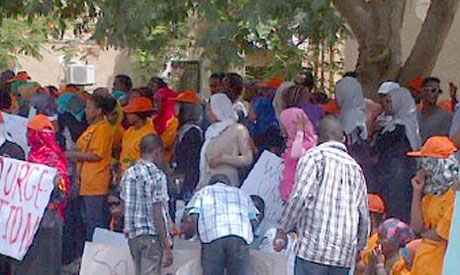
Members of Ethiopia's persecuted Oromo tribe protest harassment in Egypt and criticise building of controversial Renaissance Dam

Ethiopians protest in front of United Nations Commissioner for Refugees
Tens of Ethiopians protest in front of the United Nations Commissioner for Refugees on Sunday against Ethiopian government for building the Renaissance Dam (Photo: Al-Ahram Arabic Language news website)

Tens of Ethiopian refugees protested on Sunday against harassment in Egypt outside the office of the United Nations High Commissioner for Refugees (UNHCR) in 6th of October City.
The protesters, members of the Oromo tribe who fled Ethiopia due to political and ethnic persecution, also spoke out against Ethiopia's Renaissance Dam.
Abdel-Kader Goumy, one of the protesters, told Al-Ahram's Arabic language news website that the Renaissance Dam is intended to generate electricity, and, as such, there is no reason it should be built on the Nile, rather than on Ethiopia's other rivers.
"The tribe supports Egypt's right not to be adversely affected [by the dam]... Addis Ababa is not in need of water, rather it aims to build the dam for political purposes," he added.
Yehia Mohamed, another Ethiopian refugee belonging to the Oromo tribe, said, "Sunday's protest comes after we have suffered harassment by some Egyptians due to the Ethiopian government's decision to build the Renaissance Dam."
Mohamed explained that the Oromo have sought political asylum in countries such as Egypt, Kenya, and Somalia in order to flee sectarian persecution.
He also added that the Ethiopian government excludes the Oromo from all decision-making, including the decision to build the Renaissance Dam.
Protesters lifted Egyptian and Ethiopian flags, declaring their refusal to support a dam that will "damage Egypt and will not help Ethiopia."
On Wednesday, Egypt will demand that Ethiopia halts building on the dam, according to Reuters, citing a senior Egyptian government aide. If so, this will ramp up confrontation over a project that Egypt fears will affect its main source of water.
Ethiopia set off alarm bells in Cairo last week when it began diverting a stretch of the Blue Nile to make way for the $4.7 billion hydroelectric plant.
The Nile riparian countries have argued over the use of the Niles' waters for decades – and analysts have repeatedly warned that these disputes could boil over into war.
The high stakes around this issue were highlighted Monday when senior Egyptian politicians were caught on camera advising President Mohamed Morsi to take hostile action against the project. One advisor went on to suggest that Cairo destroy the dam.
Egypt, which has been involved in years of troubled diplomacy with Ethiopia and other upstream countries, said Ethiopia must halt work on the dam.
"Demanding that Ethiopia stop construction of the dam it plans to build on the Blue Nile will be our first step," said Pakinam El-Sharkawy, the presidential aide for political affairs, in comments carried by the state news agency MENA.
"The national committee that will be formed to deal with this issue will determine the steps that Egypt has to take," she explained. 
The Oromo make up 35 percent of the population in Ethiopia.

Correction: The percentage of Oromo in Ethiopia is 35 and not 45.
Amid dam row, Ethiopian refugees in Egypt protest rising xenophobia
Ethiopian refugees complain of increasingly frequent assaults and harassment amid Egypt's ongoing dispute with Addis Ababa over latter's planned Nile dam project
Hazel Haddon, Sunday 9 Jun 2013
Dozens of Ethiopian refugees protested on Sunday outside the Egypt office of UN refugee agency UNHCR in Cairo's 6 October City to demand protection from what they describe as increasingly frequent xenophobic attacks by Egyptians.
Protesters, mostly from the Oromo ethnic group, said that members of their community had faced several violent attacks in Egypt in recent weeks.
The alleged trend comes against the backdrop of mounting tensions between Ethiopia and Egypt over a plan by the former to build a dam on the Blue Nile.
"We have some reports of people being attacked just because of their nationality," protest organiser Jeylan Kassim told AhramOnline.
"We need the UNHCR's protection; and we need the UNHCR to raise the awareness of the Egyptian community [about our plight]."
Egyptian media has been dominated by speculation regarding the new Nile dam project since Ethiopian engineers began partially diverting the course of Blue Nile on 28 May to prepare the site for the new dam's construction.
Last week, fiery rhetoric reached a climax when a group of leading Egyptian politicians, speaking at a meeting with the president, suggested sabotage or covert interference in Ethiopian affairs to prevent the dam from negatively affecting Egypt’s share of Nile water – without realising the meeting was being broadcast live on television.
Ethiopian refugees at Sunday's protest argued that they were suffering the brunt of mounting Egypt-Ethiopia tensions.
"Two of my friends were beaten; one was sent to hospital, but they refused to treat him," claimed Mulis, an Ethiopian refugee in Egypt since 2011, while speaking to Ahram Online.
According to UNHCR Deputy Regional Representative for Egypt Elizabeth Tan, a number of Ethiopian refugees in recent weeks have reported being evicted from their homes or losing their jobs because of their nationality, along with facing difficulties obtaining medical care at Egyptian hospitals.
"The UNHCR is concerned about these allegations and calls on all Egyptians to differentiate between the political dispute with the Ethiopian government and their treatment of Ethiopian refugees who fled their country seeking asylum in Egypt," commented Tan in a written statement to Ahram Online.
"I was threatened by the owner of the building I live in," Mulis told Ahram Online. "He said, 'since you are cutting the river from us, I won't give you shelter'."
"But we're not part of the problem," he added. "We're against the Ethiopian government, and against its policies."
Around 2,500 Ethiopian refugees and asylum seekers, of different ethnic groups, are currently registered with UNHCR Cairo.

Thursday, June 6, 2013

Posted by Mesfin Tadese

“Our view would not please the Egyptians but Sudan will benefit from the [Ethiopian] dam” Sudan gvt. Spokesman

June 7, 2013

The Sudanese foreign ministry and the Egyptian embassy in Khartoum said today that have no knowledge of a visit by the director of the Egyptian intelligence as reported by government-owned and private media outlets in Cairo.
Several Egyptian newspapers quoted security sources at Cairo airport as saying that a delegation led by spy chief Mohamed Raafat Shehata has boarded Egypt Air plane to Khartoum on Wednesday morning.
It was reported that Shehata was set to discuss Ethiopia’s Grand Renaissance Dam and its move last week to divert a stretch of the Blue Nile river to make way for the $4.7 billion hydroelectric plant. The Blue Nile joins the White Nile in Khartoum to form the Nile which flows through Sudan and Egypt before emptying into the Mediterranean.
But the Egyptian consul-general in Khartoum Mutaz Mustafa Kamel denied to the independent Khartoum newspaper any truth to reports of Shehata’s visit.
The Sudanese foreign ministry said that while it has no knowledge of the visit, it suggested that it could have taken place in coordination between Egyptian President Mohammad Morsi and his counterpart Omer Hassan al-Bashir.
Egyptian President Mohamed Morsi (C) meets with Defense Minister Abdel Fattah al-Sisi (2nd L) with the Head of Egypt Intelligence Mohamed Raafat Shehata (L) and Interior Minister Mohamed Ibrahim (R) at El-Thadiya presidential palace in Cairo May 23, 2013 in this picture provided by the Egyptian Presidency
Morsi phoned Bashir yesterday to discuss the issue of the Ethiopian dam, state media reported.
Egypt, which has been involved in years of troubled diplomacy with Ethiopia and other upstream countries, said Ethiopia must now halt work on the dam and cautioned that all options are on the table to deal with this development.
“It is Egypt’s right to defend its interests, and other people have a right to follow their own interests. But there must be assurances the Ethiopian dam will not affect Egypt, otherwise all options are open,” Ayman Ali, an adviser to Egyptian President Mohammad Morsi, warned on Wednesday according to Egypt’s media.
Pakinam el-Sharkawy, another presidential adviser, told the official MENA news agency that Egypt would demand that Ethiopia cease the construction of the dam, AFP reported.
The presidency considers the dam as a “national security” issue for Egypt, Sharkawy added.
“Demanding of Ethiopia to stop construction of the dam it intends to build on the Blue Nile will be our first step,” she said, according to MENA.
Cairo has also grown concerned over what it views as Sudan’s reluctance to adopt its stance and condemn the Ethiopian project prompting criticism from some Egyptian politicians including opposition figure Ayman Nour who described Khartoum’s stance as “disgusting”.
The Sudanese information minister and government spokesperson Ahmed Bilal Osman called on Egyptian officials to refrain from insulting his country.
“Our view would not please the Egyptians and will upset them but Sudan will benefit greatly from the [Ethiopian] dam,” Osman said in a TV interview.
“The hurtful talk [against] Sudan does not serve the interests [of Egypt]” he added.
The Sudanese official further said the dam will enhance the flow of water from the huge reserves and feed the underground water while reducing dependency on rainfall. He said the benefits of the Ethiopian project will be shared by both nations.
The first phase of construction is due to be finished in three years, with a capacity of 700 megawatts. Once fully complete, the dam will have a capacity of 6,000 megawatts.
Egypt believes its “historic rights” to the Nile are guaranteed by two treaties from 1929 and 1959 which allow it 87 percent of the Nile’s flow and give it veto power over upstream projects.
But a new deal was signed in 2010 by other Nile Basin countries, including Ethiopia, allowing them to work on river projects without Cairo’s prior agreement. Sudan has refused to join this accord in solidarity with Egypt.
(ST)
Some information for this report was provided by AFP and Reuters
Source: Sudan Tribune